I still remember the day my best friend, Sarah, called me in a panic. She had painted her entire kitchen a bright, fire-engine red. “It feels like a pizza hut exploded in here,” she whispered. She was heartbroken, overwhelmed, and roughly five hundred dollars into a project that made her want to wear sunglasses indoors.
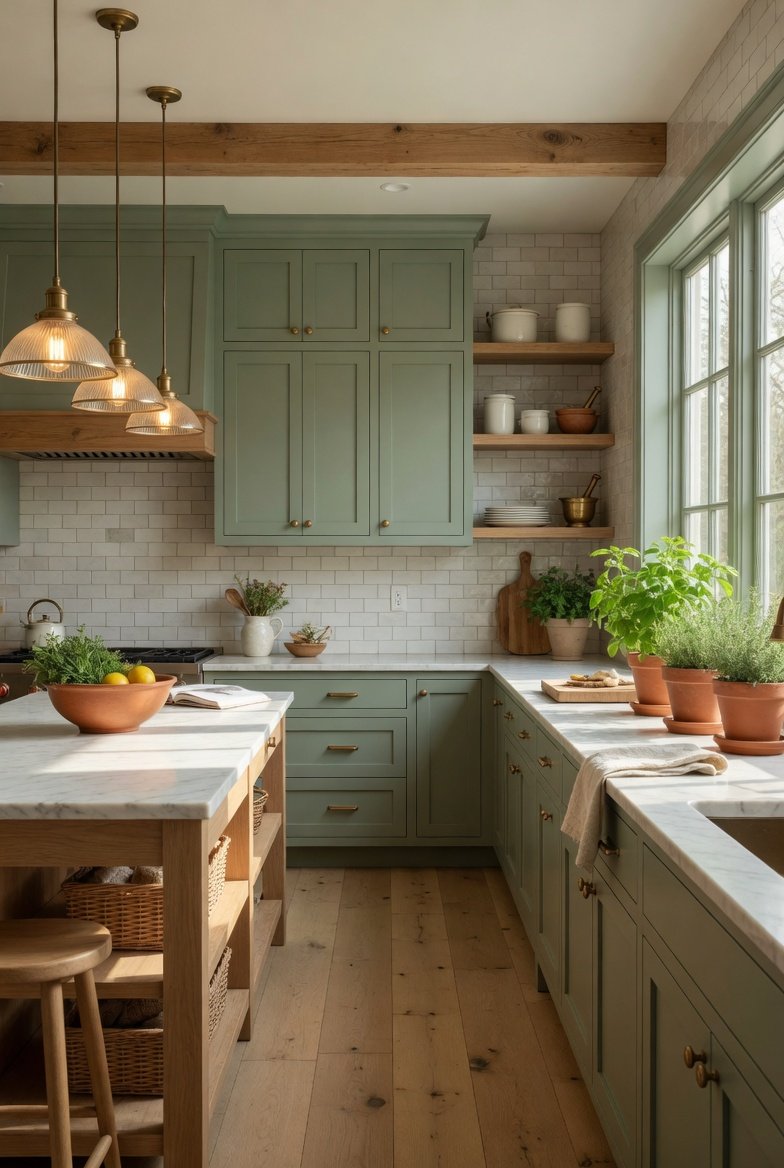
A week later, I visited to help scrape the red off the walls. On the way to the hardware store, she grabbed a single paint swatch that had fallen from a display rack. It was a soft, muted, earthy tone. It wasn’t loud. It wasn’t boring. It was a sage green kitchen waiting to happen.
We bought that paint. Three days later, Sarah sent me a photo. She sat in her breakfast nook, sunlight pouring through the window, holding a cup of coffee with a genuine smile. “I finally want to cook again,” she said.
That is the power of a sage green kitchen. It doesn’t just change the color of your cabinets. It changes the feeling of your entire home.
If you are standing in your own kitchen right now, feeling that same visual exhaustion or boredom, you have come to the right place. Over the next few minutes, I will walk you through everything you need to know. By the end of this article, you will not only love sage green as a concept—you will be ready to buy the materials and make it happen.
Let’s get started.
Why Sage Green? The Psychology of the Shade
Before we dive into paint types or cabinet styles, we need to talk about why this specific color works so well. You wouldn’t buy a car without a test drive. The same logic applies here.
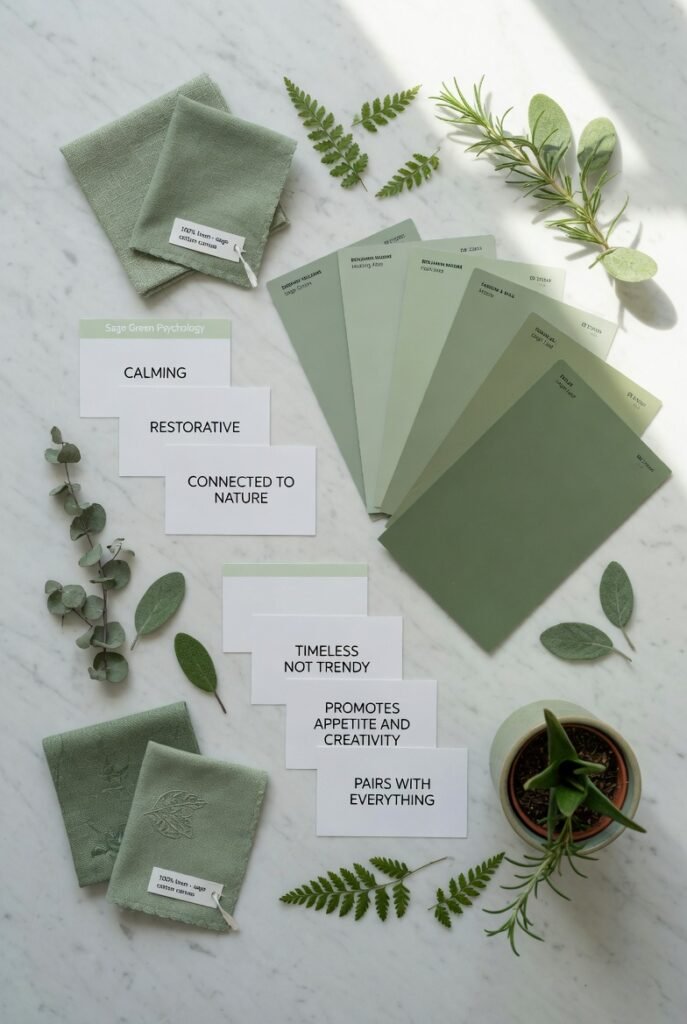
Sage green is unique because it sits perfectly between gray, green, and a hint of blue. Unlike neon lime greens that scream for attention or dark hunter greens that feel like a men’s library, sage green whispers. It is muted, dusty, and organic.
The Calm Effect
Think about the last time you took a deep breath while walking through a forest. That feeling of peace and quiet stability is exactly what sage green brings into a kitchen. Kitchens are naturally chaotic. You have hot ovens, sharp knives, running water, and usually a toddler or pet underfoot. The color sage green acts as a visual anchor. It lowers your heart rate without you realizing it.
I learned this the hard way. A few years ago, I painted my own kitchen a bright, sterile white. I thought it would look clean. Instead, it looked like a hospital operating room. Every crumb was visible. Every shadow felt harsh. I constantly felt like I needed to clean. It was exhausting.
When I switched to a sage green kitchen, the transformation was immediate. The space felt softer. My morning coffee routine went from a frantic race to a quiet ritual. The sage green absorbed harsh light and reflected back a gentle warmth. That is the psychology at work—sage green says, “Relax. You are safe here.”
The Versatility Factor
Furthermore, sage green is arguably the most versatile color on the market. It plays nicely with virtually every material.
- Stainless steel appliances? Sage green makes cold metal look intentional and modern.
- Vintage brass fixtures? Sage green highlights the gold without looking gaudy.
- Wooden butcher block countertops? Sage green and wood is a match made in heaven.
Consequently, when you invest in a sage green kitchen, you are future-proofing your home. Even if you change your decor style from farmhouse to modern to bohemian, sage green adapts. It is the chameleon of the color wheel.
Step-by-Step Guide: How to Build Your Sage Green Kitchen
Now, let’s get practical. Reading about colors is fun, but creating the space requires a plan. Below is a five-step process. Follow these, and you will avoid the expensive mistakes that Sarah (and I) made.
Step 1: Choose Your Weapon – Paint vs. Cabinets
The first decision is whether you will paint existing cabinets or buy new ones. Both routes lead to a sage green kitchen, but they have different costs and timelines.
- Painting Existing Cabinets: This is the budget-friendly hero. If your current cabinets are solid wood or MDF in good condition, you can sand, prime, and paint them sage green. The cost is usually under $300. The downside? It is messy and takes about a week of drying time.
- Buying New Sage Green Cabinets: This is the “I want it perfect” route. Ready-to-assemble (RTA) or custom cabinets in sage green offer a factory finish you cannot achieve with a brush. The color is consistent, the doors align, and the finish is durable.
My advice: If you have more time than money, paint them. If you have more money than time, buy the cabinets. However, if you are a beginner, buy one pre-finished sage green cabinet door first. Hold it in your space. Look at it in the morning light, afternoon light, and evening light. This single step saved me from buying a shade that looked awful under my fluorescent lights.
Also Read: 13 Orange Bedroom: The Ultimate Guide to a Vibrant, Cozy, and Stylish Sleep Space
Step 2: The Undertone Trap (Don’t Ignore This)
Here is where most people mess up. Not all sage green is created equal. Some shades lean warm (yellow-beige undertones) , while others lean cool (blue-gray undertones) .
- Warm Sage Green: This looks incredible with oak floors, cream countertops, and brass hardware. It feels cozy and Mediterranean.
- Cool Sage Green: This looks sharp with white marble, black fixtures, and gray floors. It feels clean and spa-like.
To decide which one you need, look at your fixed elements. Is your floor tile gray? Go cool. Is your floor warm honey oak? Go warm. Ignoring undertones is why so many people end up hating their sage green kitchen after the first night. They buy the first swatch without checking the undertone.
Step 3: Lighting is Everything
A sage green kitchen lives and dies by its lighting. Because sage green is a muted color, it reflects light differently than white or black.
- Natural Light: If you have a south-facing kitchen with tons of sun, your sage green will look lighter, brighter, and almost silvery. This is gorgeous.
- North-Facing (Low Light): If your kitchen is dark, a cool sage green can look gray and depressing. In this case, you need a warmer sage green with yellow undertones to bounce light around the room.
- Artificial Light: Avoid cheap, cool white LED bulbs. They will make any sage green look sickly and washed out. Instead, buy warm white (2700k to 3000k) bulbs. This will make the green in your sage green kitchen look rich and herbal.
Step 4: Pairing Your Sage Green with Countertops
You have the walls or cabinets. Now, what goes on top? The countertop is the bridge between your sage green and the rest of the house.
Here are three safe bets that always work:
- White Quartz or Marble: This is the classic pairing. Crisp white against muted sage green creates a clean, airy, modern farmhouse look. It is fresh and timeless.
- Butcher Block (Walnut or Acacia): This is the organic, earthy route. The warmth of wood grain brings out the natural side of sage green. It makes the kitchen feel like an old English cottage. Just be prepared to oil the wood regularly.
- Black Soapstone or Granite: For the bold reader. Dark, matte black countertops make sage green look sophisticated and moody. This is a high-end restaurant look. It hides crumbs well, too—a bonus for messy cooks like me.
Avoid yellow granite or busy, speckled laminate with sage green. Trust me. The patterns will clash, and your kitchen will look dated within a year.
Step 5: The Hardware Handshake
Finally, let’s talk about the jewelry of the kitchen: the knobs and pulls. The wrong hardware can ruin a sage green kitchen in seconds.
- Brass/Bronze: This is the #1 choice. Warm gold tones pop beautifully against cool green. It feels expensive, even if you buy cheap hardware.
- Matte Black: This creates a modern, high-contrast look. If you want a sage green kitchen that feels edgy and urban, go with matte black handles and a matte black faucet.
- Chrome/Polished Nickel: This works best with cool sage green and white marble. It is a cleaner, more clinical look.
Here is an anecdote: My neighbor, Dave, painted his cabinets sage green but left old, yellowed plastic handles on them. It looked terrible. The green felt dirty. I bought him a pack of cheap brass knobs ($1.50 each) and swapped them out. He gasped. The sage green suddenly looked expensive and intentional. Hardware is the difference between a “DIY project” and a “designer home.”
Real-Life Stories: How Sage Green Changed These Kitchens
To convince you further, here are three short stories from real people who took the plunge on a sage green kitchen. These are not professional designers. They are regular folks.
The Renter’s Revenge (Maria, 28)
Maria lived in a beige-box apartment with laminate countertops and a landlord who refused to let her paint. She was miserable. She discovered removable sage green peel-and-stick wallpaper. She covered only the backsplash behind her stove. Then she bought a sage green countertop microwave and a set of sage green canisters.
“It wasn’t a full kitchen,” she told me. “But when I stood at the stove, all I saw was that beautiful green. It was my little oasis. My friends asked if I had moved to a new building.”
Takeaway: You don’t need a full renovation. Even small sage green accents can shift the energy.
The Resale Risk (Tom & Lisa, 45)
Tom and Lisa were terrified. They were about to sell their house, and every realtor told them to paint everything “agreeable gray.” But Tom loved sage green. They decided to take a risk. They painted their island sage green and kept the perimeter cabinets white.
The house went on the market on a Friday. By Sunday, they had three offers. Every buyer’s note mentioned “the beautiful green island.” The eventual buyer said, “I fell in love with that color. It made the kitchen feel like home.”
Takeaway: Sage green is not a liability. In today’s market, it is an asset. It signals taste and tranquility, not risk.
The DIY Disaster Turned Dream (Carlos, 62)
Carlos tried to paint his cabinets sage green without sanding or priming. The paint peeled off like sunburned skin. He was ready to give up.
Instead, he hired a local spray painter. The cost was $800. The painter used a bonding primer and three coats of high-end sage green enamel. When Carlos sent me the after photos, I thought he had bought brand new cabinets. The finish was smooth as glass. He said, “I should have paid the pros from day one. But I don’t regret the color for a second.”
Takeaway: If you are not a patient person, do not DIY the painting. Pay a professional to spray your sage green cabinets. It is worth every penny.
The Shopping List: What to Buy Right Now
You are convinced. You want the sage green kitchen. But where do you start? Below is a priority-based shopping list.
Priority 1: The Big Ticket Items (Buy these first)
- ** Sage Green Shaker Cabinets:** Search for RTA (Ready-to-Assemble) options. Shaker style is timeless.
- ** Sage Green Tile Backsplash:** Look for ceramic or zellige tile in a matte finish. Glossy can look cheap.
- ** Sage Green Paint:** Look for cabinet coat or advance formulas from brands like Sherwin-Williams (Evergreen Fog) or Benjamin Moore (Sage Mountain).
Priority 2: The Accents (To test the waters)
- ** Sage Green Canisters:** Airtight jars for flour, sugar, and coffee.
- ** Sage Green Dutch Oven:** Le Creuset makes a famous one. It looks stunning on the stovetop.
- ** Sage Green Dish Towels:** The easiest way to start. Buy 100% linen for a rustic feel.
- ** Sage Green Rug:** A washable runner in front of the sink softens the floor.
Priority 3: The Tools (For DIY Painters)
- High-Bonding Primer: Essential. Do not skip this.
- Sanding Sponges (220 Grit): You must scuff the surface.
- Foam Rollers: To avoid brush strokes on your sage green cabinets.
- Floetrol Additive: This slows drying time so paint self-levels. It is the secret to a professional finish.
Common Mistakes (And How to Fix Them)
Even with a step-by-step guide, mistakes happen. Here are the top three errors when building a sage green kitchen.
Mistake #1: Too Much Gray
Because sage green contains gray, some people pair it with gray floors, gray counters, and gray walls. The result is a sage green kitchen that looks like a photograph from 2012. It feels cold and lifeless.
The Fix: Inject warmth. Add a wooden cutting board, a jute rug, or a brass vase. You need texture. Sage green needs a friend. Don’t leave it alone in a gray desert.
Mistake #2: The Wrong White
If you use a stark, blue-white (like “Snowbound”) next to sage green, the contrast is jarring. The green will look muddy, and the white will look blinding.
The Fix: Use a warm, creamy white (like “White Dove” or “Swiss Coffee”) for your trim and ceiling. This warm white holds hands with sage green beautifully. It looks natural, like cream and herbs.
Mistake #3: Forgetting the Greenery
A sage green kitchen actually needs real plants. Because sage green is a muted, artificial color, adding a real, vibrant green plant (like a pothos or basil plant) creates depth.
The Fix: Put a small herb garden on the windowsill. The bright, living green of the basil will make the painted sage green cabinets look grounding and deep. It creates a layered green effect that is highly photogenic.
The Long-Term Benefits: Why You Won’t Regret This
Trends come and go. Millennial pink is dead. Chevron patterns are buried. But sage green?
Sage green is what designers call a heritage color. It has been used in kitchens for over 200 years. In Victorian times, it was “celery green.” In the 1940s, it was “kitchen green.” In the 1990s, it was “herbal green.” The name changes, but the shade remains.
Because sage green is found in nature (on leaves, moss, and stones), your brain never gets tired of it. You will wake up five years from now, walk into your sage green kitchen, and feel the same calm you felt on day one.
Compare that to a navy blue kitchen, which can feel heavy. Or an all-white kitchen, which feels sterile. Sage green is the Goldilocks of kitchens. It is not too dark, not too bright, not too trendy, and not too boring.
Furthermore, a sage green kitchen increases the perceived value of your home. Real estate agents report that kitchens with soft, natural colors sell faster than those with bold, aggressive colors. Buyers see sage green and think, “This is clean. This is peaceful. I can live here.”
Final Verdict: Should You Buy Into the Sage Green Kitchen?
Let me be blunt. If you want a kitchen that screams for attention, sage green is not for you. Go buy a red lacquer cabinet.
But if you want a kitchen that hugs you when you walk in? A kitchen that makes a 6:00 AM coffee routine feel like a retreat? A kitchen that looks expensive without costing a fortune?
Then yes. Buy the sage green paint. Order the sage green tiles. Swipe the card for the sage green Dutch oven.
I have walked you through the psychology. I have given you the step-by-step guide to avoid disasters. I have shared the stories of Sarah, Maria, Tom, Lisa, and Carlos. They all took the risk, and none of them regret it.
Your kitchen is the busiest room in your house. It deserves a color that brings you peace, not anxiety. It deserves sage green.
Here is your final instruction. Stop reading. Go to the hardware store or open a new browser tab. Buy one sample pot of sage green paint. Paint a two-foot by two-foot square on your wall. Live with it for 24 hours.
I promise you, by tomorrow night, you will be planning the rest of the renovation. Your sage green kitchen is waiting for you. Go build it.